Here’s a myth I want to kill straight away.
Most people think selling a new idea – whether that’s a product, a process, or just getting your team to do something differently – is about convincing. Find the right argument, build the right deck, get the right person in the room on the right day… and then – convince them.
That’s wrong. And it’s the reason most good ideas die.
When you convince somebody, you create agreement in the moment. That’s it. The moment they leave that context, the agreement goes with it. They’re back at their desk thinking, why did I say yes to that? And now you’ve got someone who’s technically on board but doesn’t actually understand why – which means the moment things get hard, they’re gone.
We see it constantly. You talk more than you listen. You lead the conversation. You push. And when they push back, you push harder. That’s not selling, it’s convincing, and the thing is, convincing doesn’t stick.
If you’re not convincing, what are you actually trying to do?
You’re trying to help people see progress. Not your progress – theirs.
That’s the whole shift. The question isn’t “how do I get them to agree with me?” It’s “how do I help them understand the progress they could make?”
And before you get there with anyone else, you have to get there with yourself first. (Listen to the podcast version of selling new ideas.)
Start below the watermark
We use the phrase “forces of progress” a lot – it comes from Jobs to be Done. The idea is that every decision to change, or not change, is driven by four things: the pushes away from where you are now, the pull toward something better, the habits keeping you where you are, and the anxieties about what changing actually costs you.
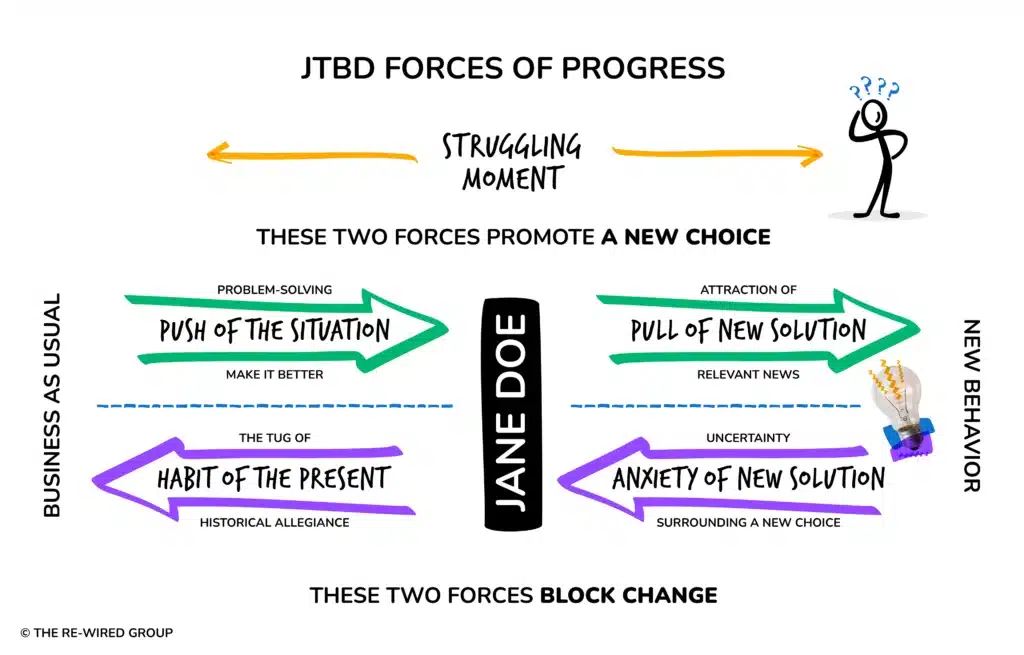
Most people – and I mean almost everyone – spend all their time on the pull. The future. The bright shiny things. Here’s what the new system looks like. Here’s what changes when we bring in this methodology. Here’s the upside.
What they skip is everything below the watermark. The habits. The anxieties. The uglies in the pit of your stomach that you don’t really want to look at.
Here’s the thing though: those things don’t disappear just because you ignore them. They come back. Every time you try to sell your idea, every time you hit resistance, every time implementation stalls – that’s the below-the-watermark stuff surfacing. And if you haven’t done the work to understand it in yourself first, you’ll get blindsided every single time.
Spend more time on why you need to change than on describing what the change looks like. The pushes are your fuel. Without them, the aspiration to change has no friction. No traction. People dream, they nod along, and then they go backwards. Because going backwards is always easier than going forwards.
You’re not just going to your boss
Once you’ve done that work on yourself, the next thing most people get wrong is who they actually need to talk to.
They think: I need to convince my boss. So that’s the only person they prepare for.
But look laterally. Look up. Look down. Sometimes look outside your area entirely – because there will be people who are affected by what you’re trying to do who don’t even know they’re in the picture yet.
The people who own the label; the people who control the budget; the team downstream who’s going to have to change how they work because of a decision made three steps removed from them.
Those people are what I’d call a frictional coefficient.
They’re not against you, necessarily, they just have their own things to protect. And if you haven’t thought about them, they’ll slow you down or stop you – not because they’re difficult, but because you never helped them understand their own progress.
And the skeptics? I love the skeptics. Don’t avoid them. They will make your idea better, and they almost never say don’t do it. They say do it, but here are the constraints. You need those constraints. They’re what makes the plan real.
Build a manageable list. Two or three people at each level. Not a hundred. The people who will help you see the bigger picture and whose input will either get you permission to move or sharpen what you’re doing.
Go talk to them – but don’t pitch them
Here’s where most people fall apart.
They go in with a presentation. Pre-planned questions. A script. And then they spend the whole conversation trying to get through their slides instead of actually listening.
Real conversations don’t work like that. What you’re doing when you talk to these people is trying to understand their forces of progress. Why would this change be good for them? Why wouldn’t it? What does their future look like? What are they scared to give up?
And then – this is the critical part – you let them swim around in their own answers. You don’t drill to the next question the moment they finish speaking. The first answer is almost never the real answer. People need time to deepen it, contradict it, change it entirely. If you shut that down, you’ve already stopped listening.
When you ask questions from your own agenda, you’re convincing. When you ask questions that help someone articulate what they actually care about, you’re aligning. Those are completely different conversations.
Build the plan around everyone’s progress – not just yours
When you’ve done those conversations, don’t just go back and build what you originally planned.
Take what you learned and design something that reflects the progress the people you talked to want to make. Map the metrics that matter to each group and show how this serves more than just the thing you wanted in the first place.
If you can, bring more than one option. Not because you’re uncertain – but because options act like a mirror. They help people see their own forces of progress reflected back, and they give people a real role in shaping the outcome rather than just being asked to say yes to yours.
The yes is not the finish line
This is the part that trips everyone up, even people who’ve done everything else right.
The sale doesn’t end when you get agreement. It ends when the habit is built. When the change has actually happened and the new way is the default. Everything between the yes and that outcome is still your job.
Marketing, sales, and customer success aren’t three separate systems – they’re one. And internally, it’s the same. Getting alignment, implementing the idea, sustaining the progress: that’s one continuous process. If you hand it off after the yes, don’t be surprised when it unravels.
Interested in learning more? Check out demand-side sales.
Start somewhere small
If you want to actually practice this, don’t start with your biggest political initiative at work.
Start with your family. A vacation. A movie. Something where the stakes are low and the list of people is short. Get used to discovering your own below-the-watermark stuff first. Then practice drawing it out of others – without drilling them, without telling them their own context, without jumping to the next question too soon.
It sounds simple when you lay it out like this. It isn’t. But once you stop trying to convince people and start helping them see progress, you’ll be surprised how much faster things actually move.
The uglies in the pit of your stomach? Once you get comfortable talking about those – yours and theirs – that’s when real change happens.