
When somebody asks for a demo, the first question isn’t what to show them – it’s to understand where they are.
A common mistake companies make is when a demo request comes in, you think it means somebody’s ready to buy.
Unfortunately, most of the time it doesn’t. The same request can mean three completely different things depending on where that person is in their buying timeline. And the thing is, if you only have one type of demo, you’re going to miss most of them.
I’ve been studying how people buy for a long, long time. One of the craziest things I see in B2B is that the sales process gets built around how we want to sell, not how they want to buy.
Most salespeople think those are the same thing; they are really not.
Here’s a simple test.
When you’re next speaking with a prospect, ask them where they are in your sales process. I bet you they can’t answer it.
That’s because they don’t have a sales process, because they’re not selling, they’re buying.
But ask them where they are in their buying process and they’ll tell you straight away. “Oh yeah, we’re just starting.”
That’s the conversation you want to be having.
The buyer’s timeline
When we interview people about how they actually bought something, the stories aren’t random. They all follow a timeline.
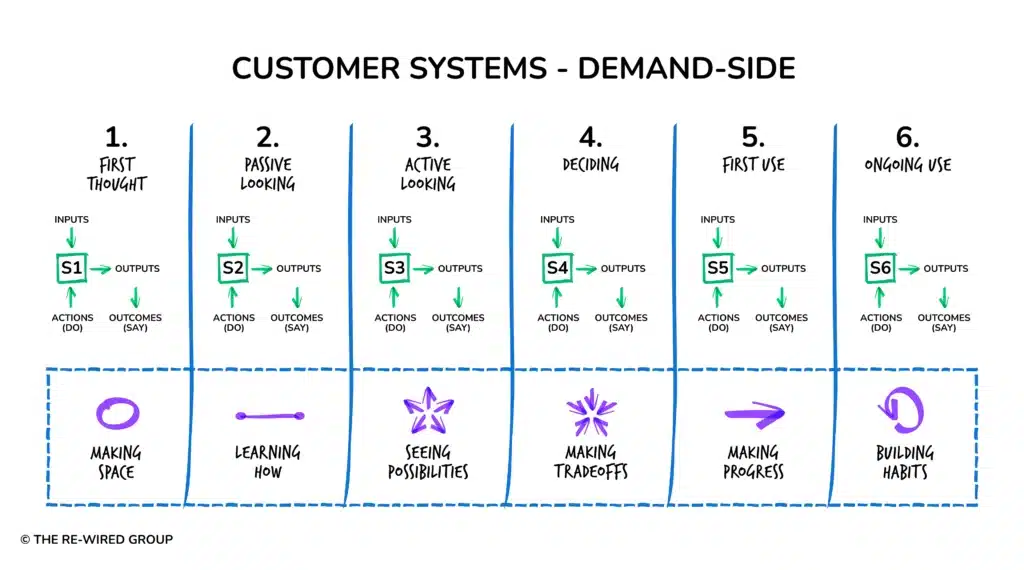
First thought.
Something happens that opens up a question. Clay Christensen used to say questions create spaces in the brain for solutions to fall into. When we worked with Casper, the best thing you could do was ask “How’d you sleep last night?” and stop there. Add “Need a new mattress?” and the answer is almost always no.
Passive looking.
This is where they have noticed the problem, and now they’re trying to figure out if it’s big enough to do anything about. Most people try a thousand other things before they realize it’s the mattress.
Active looking.
Now they’re seeing possibilities. What could I do with this thing? What would it look like for us?
Deciding.
This one is about trade-offs, because they can’t have it all. What am I willing to give up to get this? Then it locks in, they make progress, and if you’ve done your job, it becomes a habit.
The thing to understand is that each stage is its own system. There’s something they need to learn to move to the next one.
First thought is about making space.
Passive looking is about learning the problem.
Active looking is about seeing what’s possible.
Deciding is about making the trade-offs.
Sorry, but it’s not a funnel
Everybody wants to draw this as a funnel.
The thing is, it’s not – people go backwards.Somebody can be right in the middle of deciding and something changes. The budget gets frozen, a new boss shows up, a pandemic hits.
All of a sudden they’re back in passive looking, because something that made sense yesterday doesn’t make sense anymore.
And people can’t go from passive looking straight to buying. It doesn’t work. There’s a set of dominoes that have to fall, and you can’t skip them just because your quarter ends on Friday.
The same request… but a totally different demo
When somebody asks for a demo, the first question isn’t “what do we show them?” It’s “where are they?”
If they’re in passive looking and they ask for a demo, what they’re really saying is help me see the problem. Tell me stories about how this works for people like me. They’re not ready for your feature tour. They’re still trying to figure out if the problem is worth solving at all.
If they’re in deciding and they ask for a demo, it’s a completely different request. What they’re really asking is how do I make sure this isn’t going to fail? They want to know what they’re giving up, what it’s going to take to get it in, and how they can test it before they commit.
Same words. Totally different demo.
Most companies will go and build one demo which is built ultimately to close. This means it works great for the people who are already deciding and falls flat for everybody else. Then the deal goes quiet and we call it ghosting. The reality is we either overwhelmed them, or we answered a question they weren’t asking yet.
What Autobooks did
Autobooks is a payments and accounting platform that small businesses get through their bank’s online banking. When we started working with them, they were really struggling with their demo. Every 90 days they’d redesign it, and they still couldn’t figure out what was going wrong.
A demo that landed with one prospect would bomb with the next.
When we dug in, the problem wasn’t the demo itself. It was who the demo was for. It had been built to close deals, so it only really worked for people in deciding. For anybody in passive or active looking, it was just too much, too soon.
So they stopped trying to build one perfect demo and built three different kinds. These were:
- One around passive looking – focused on storytelling. Help them understand the problem and whether it’s big enough to act on.
- One around active looking: focused on showing them the features and what’s possible.
- One around deciding – this was focused on talking through the trade-offs they’d have to make, and how they could test it.
The results were impressive.
As a result of approaching it in this manner, the team at AutoBooks nearly cut their time to close in half. Lead conversion doubled, because they could qualify leads better, and just as importantly, the leads could qualify themselves better.
They even changed their sales funnel to use the language of the timeline.
They didn’t get a better demo, instead they developed the right demo in front of the right person at the right time. You can read the full Autobooks case study here.
One timeline, one team
One more thing. The buyer’s timeline doesn’t care about your org chart. Most companies hand the customer from marketing to sales, then from sales to customer success. So much gets lost in those handoffs. If marketing opens the space the wrong way at first thought, customer success ends up inheriting all the wrong expectations a year later.
They’re not three teams. They’re one team helping somebody make progress. In my experience, when you get them working off the same timeline, they spend a lot less energy fighting each other and a lot more fighting the competition.
Your assignment
Pull your last ten demo requests.
For each one, ask:
- Where were they on the timeline when they asked?
- What were they actually asking for?
- Did our demo answer that question, or a different one?
Nine times out of ten, you’ll see the pattern pretty quickly.
If you want to go deeper on how people buy and how to build your sales process around it, that’s what Demand-Side Sales 101 is all about.
And if you’d like help mapping your own buyers’ timeline, book a call with us.