
Flip the lens: the series that looks at changing your perspective on concepts you thought you already understood.
Here’s a belief many founders carry into a sales call, a board review, or a conversation with a skeptical engineer: that selling is about convincing. That if you build a tight enough argument and paint a vivid enough picture, the other person will come around.
I’m afraid to tell you that it’s a myth, and a really expensive one at that.
When you try to convince someone, you don’t create a customer, you create something known as buyer’s remorse. You build a moment of pressure where they think, “Okay, yeah, I’ve got to do this.” Then they walk out of that context you manufactured, and the next thing they think is, “Why did I do that?”
They never saw the reason to change. That’s not a yes; it’s a yes you’ll likely be apologizing for later.
So if we’re not trying to convince people, what are we trying to do?
We’re trying to help them see progress, the progress they can make. And when we talk about progress, we mean what life looks like on the other side of the change, and why it’s better for them.
There’s a line we come back to constantly:
“When I paint the picture for you, I’m convincing. When you paint the picture for me – when I ask the questions and you answer them – you create your own context.”
You can’t hand someone their reasons; they have to find them. Your job is to help them understand the bigger context they’re already in: the pushes on them, the things they can’t quite see yet.
Because here’s the truth about people, including your customers: it’s not that they don’t want to change…. Change is just hard. Going back to the status quo is always easier than keeping a change going.
Everybody has aspirations, and aspirations are fuel, but with no friction and no traction they stay exactly where they are. They’re dreams, and dreams don’t cause switches or changes in action.
Most people, when they try to help someone “see their context,” do it one of two ways, and both are terrible.
- The first is telling people their context.
“Well, you’re in this situation, doing this, so obviously you need that.” That’s not helping anyone understand anything. That’s convincing wearing a clever hat.
- The second is drilling.
You fire off questions but never dig into the answers. “What’s going on in your business today?” Great. “And what do you want the future to look like?” You gave them no time to sit in the first answer.
You have to give people room to swim around in an answer, to immerse themselves in it, deepen it, even change it. Our first answer is almost never our best answer, that’s because typically, we catch people off guard. Ask again, give it space and trust me, you’ll get the real one.
This is exactly why we can’t stand prefabricated presentations and pre-planned question lists. The moment you’ve got all your questions loaded in your head, your job quietly becomes getting through your questions.
But your real job is to get to the answers that matter to them. Do it right and they’ll lead you there. I’ve had sales calls where I asked one question and we talked about that answer for an hour.
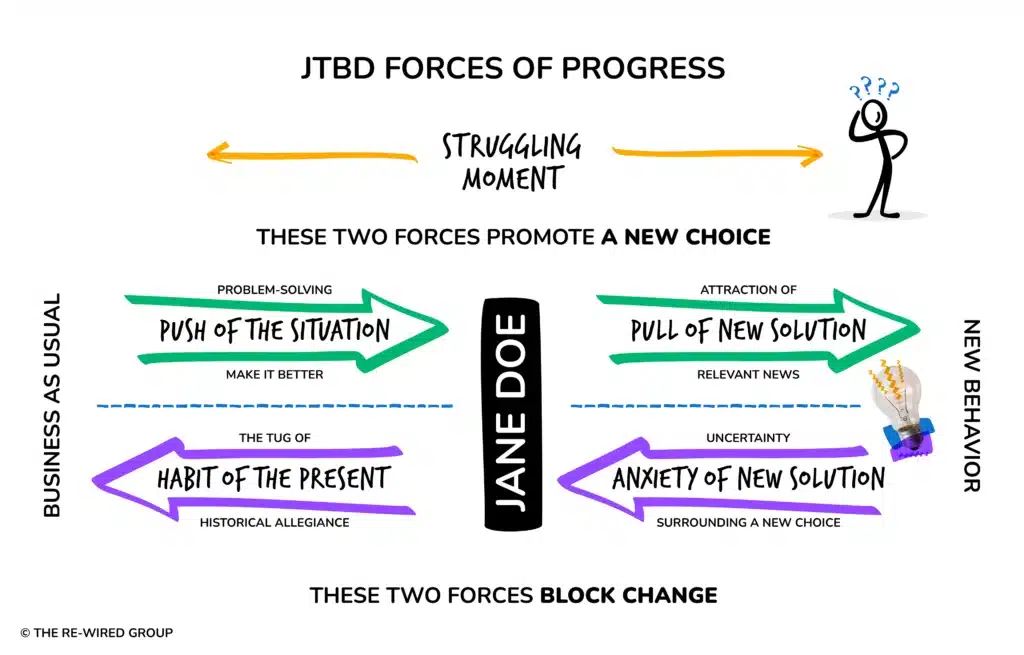
The Forces of Progress – just one tool offered to help dig into where there’s demand for your offer
This isn’t just for the people with “sales” in their title.
Whether you’re the developer, the designer, the marketer, or the CEO, you are selling an idea. Selling is just helping others align on the progress you all want to make.
So what do you actually do? Roughly three things.
- First, understand why you want to change – for yourself and for the company.
Spend less time describing the shiny new thing and more time on why you need it. The pushes, and especially the anxieties and habits, the stuff below the watermark. When I ask people what they’re anxious about, they say “nothing.” That’s BS.
Every change has unknowns in it – the known unknowns (“I don’t know about this part”) and the unknown unknowns that only surface as you get closer. Your forces of progress aren’t a slide – they’re a living, breathing document. - Second, figure out who you need to talk to.
Not just your boss – that’s the convincing reflex again. Look laterally, look up, look down, sometimes outside your world entirely. Find your allies and find your skeptics. Then go talk to them.
Not to convince them, to discover their forces of progress. Bring two or three options, never one, because one idea is so easy to shoot down. - Third, build a plan – a real one. Not steps. Direction, scope, boundaries, metrics, resources, next steps. Then implement and watch how it rolls out, because here’s the part everyone gets wrong: sales doesn’t stop at “yes.” Yes is just the commitment to change. It isn’t the change. The work ends when progress is made and the new habit is built. That’s why marketing, sales, and customer success aren’t three systems. They’re one.
And the hard part underneath all of it? Every conversation is an interview.
The difference between a real interaction and a fake one is whether you’re working from their demand or your supply. The second you ask, “Don’t you want to get better?” – that yes/no question – you’re back to convincing.
Here’s your homework.
Next time you need to sell something, start small. Not the boardroom – the dinner table. Practice finding the uglies (the anxieties and fears underneath a decision) in the pit of your stomach, then help the other person name theirs. Once you can talk about the uglies, you make progress faster.
Re-Wired takeaway: stop trying to win arguments, and start helping people see what they couldn’t see before.